Tuesday, May 22, 2012

The Wheels On the Bus Go Round and Round

Friday night, as I prepared my peanut butter and banana sandwich and slipped it into my freshly washed Ziploc baggie (in which Tumelo later made me transfer to a Tupperware since he said people would think I was “somehow” if I showed up with my sandwich in a plastic baggie) I felt like a young school kid.  Even Saturday morning, as the sound of my wristwatch alarm beeped into my ear at 20 minutes to 6, I was excited.  I was headed on my first school trip in South Africa with one of my primary schools.  We were traveling to another village for a soccer and netball tournament.  One of the teachers called my ever-so functioning phone (I dropped it into my bucket last week…not my proudest moment so far…) and told me that he would be by to pick me up shortly.  To my surprise, and to the great upset of African time, he rolled up 3 minutes early.

                As we entered the school ground, I suddenly felt underdressed.  Here I was, clad in jeans, my BU sweatshirt (remember, it’s now “winter” here), my Nike baseball cap, and my pair of TOMS that I should reserve only for Sundays as they have become ever so holey.  Meanwhile, my students were dressed in their very best, which I can’t blame them since they do have to wear their school uniform every Monday-Friday.  Girls had new hairdos, donned more bling than my sisters and I combined have ever owned, and were powdered in makeup.  The boys had fly caps, nice tekkies, and sported sunglasses despite the fact that the sun was still seemingly fighting its own alarm clock.  When our bus (The Great North Transport) drove up, all of the learners piled in with their blow horns, athletic uniforms, and bags.  We were off.

                Prior to reaching our destination, we stopped at the SPAR in Giyani (SPAR is like Giant or Shaw’s).  Nice, but definitely not yet reaching Wegman’s or Trader Joe’s quality.    We were stopping so that the kids could buy food.  I had assumed I’d be home by 12:30, or 1 at the latest.  When I told Maggie and Tumelo this, they laughed, telling me to pack food just in case.  Maggie told me I wouldn’t be home until maybe 3, while Tumelo joked saying I’d be home at 8:30.  Although I didn’t need to buy anything, I went in to greet my favorite SPAR employees (this is where I do all of my food shopping so they know me and the other PCVs now) and to use the toilet.  Once I was done, I waited by the cash registers to keep an eye on the kids.  I couldn’t help but smile when I saw the kids’ baskets filled with more sugar-filled items than is likely healthy for a family of four for an entire year.  One of the learners tried to buy 5kg of ice cream, but thankfully the cashier advised him to put it back, knowing it would melt within minutes.  I swear the kids tried to buy out the SPAR, buying cakes meant for momentous celebrations like birthdays and weddings, lollipops, yogurt drinks, Zimba chips, and more.  You see, when these learners go on a trip, their parents treat them, giving them R40 or even R50 (this equates to about $6 or $7).  On any given day, the most these kids see is R5.  With this much money, they go hog wild, splurging at everything in sight.  Unfortunately, some of the younger ones still haven’t quite mastered the art of adding/reading, so there were quite a few times when items had to be put back, and kids couldn’t buy everything that they wanted.  There were even a few times that the Manager had to be called over to void orders.  Before we left SPAR, one of the teachers, a real go-getter, sweet-talked the manager into giving all of the teachers/chaperones free cold drink and a DVD to one of the learners for the business that our school brought in that morning.  As obliging as the manager was, I couldn’t help but to feel a little awkward taking the cold drink.

                Before long, we arrived at the school where the competitions would take place.  It took a little under 2 hours from our starting destination, which isn’t terrible as we traveled using mostly gravel roads.  I assumed that the games would begin immediately, but as always, I had assumed wrong.  When we pulled in, we were all ushered to be properly welcomed (South Africa is huge on making sure people feel welcome and at home…Ubuntu).  After a few minutes, the teachers and I were taken to the staff room where we were presented with scones, muffins, and of course, cold drink.  I guess my peanut butter and banana sandwich would just have to wait.  The muffins were delicious!  Once we finished, we were taken back outside in order to continue with the welcoming ceremonies.  The principal and the deputy principal thanked us for traveling and coming (all in Xitsonga).  Following their speeches, some of the girls danced Cibalani (the traditional Xitsonga dance which I love, but cannot do for the life of me) and some of the boys did their traditional dance. 

                The girls (JV as we would term back home) Netball team kicked off the games.  They started things off on the right foot for our school as they crushed the other team, winning an impressive 7-1.  It didn’t hurt that the scorer on the team, one of my Grade 7 girls, is almost as tall as the net.  This was quickly followed by the start of the boys (again, JV) soccer game.  The boys also fared well, tying in a 1-1 game.  Although a penalty kick was considered, all involved decided that “friendly games” do not include penalty kicks, which I thought was fair.  Next came the girls (Varsity) Netball team.  I thought the first game was exciting, but this one was crazy!  For this one, our girls outdid them in what I think was a final score of 15-1.  I almost felt bad for the other team…

By now it was a little after two, and I was feeling quite glad that I had brought a baseball cap as it no longer felt like the “winter” of the early hours.  The kids and I were shepherded to the school yard for celebratory pictures.  I gladly posed, very excited for the kids’ win.  Strangely enough, I was asked to pose for the opposing team’s pictures as well…I obliged.  Just as I thought we were ready to board the bus, all of the teachers were again called to the staff room.  This time, we were presented with pap, 3 different types of chicken (fried, cooked, and chicken parts), cabbage, salad, sauce, and cold drink.  It now dawned on me why my fellow teachers hadn’t come prepared with food…they knew we would be taken care of and I’m not sure why I haven’t realized this yet.  Everywhere you go in South Africa, people give their very best to make sure that you are content.  My poor peanut butter and banana sandwich took the backseat once again.

Following our lunch, and feeling quite food comatose, I headed over to cheer on our boys (Varsity) soccer team.  I watched in awe as these boys played soccer barefoot, taking no notice to the rocks or prickles in the field.  The other team was HUGE, and my fellow teachers and I agreed that some of them had to be borrowed from the high school.  Despite their height advantage to our boys, our school again proved victorious in a final score of 2-0. 

At lunch I had commented to the HOD of the school we were visiting (who also turned out to have taught the principal I work with when he was in primary school) how much I enjoyed the dances earlier in the day, saying that he should be very proud of his learners.  As I am sure I have mentioned in at least one previous blog, I really, really need to zip my lips sometimes.  Wanting only to make me happy, all of the sound equipment was taken back outside and the learners performed yet again.  More speeches were made, and at last we boarded the bus to make our trek back home.  Accidentally, we left one of our teachers, so after about 5 minutes we had to turn back around.  Luckily he was very forgiving of our mistake.

During the trip back home, as I watched the sun set (nothing quite like an African sunset), I realized how proud I was to be a part of this school family, a part of the staff, and a part of these learners’ lives.  I thought about how each and every one of them, against all of the odds that they face on a daily basis, is a winner in every sense of the term.  Despite the fact that they live in a rural and impoverished village, despite the fact that many of them don’t have one or both parents, despite the fact that water and food is far and few between at times they all show up to school every day willing and eager to learn.  I have never once heard any of these kids complain, and I only ever see them smiling.  Maybe they needed this day and these wins to feel like winners (because, hey, we all can use a win every once and a while, right?).  But to me, this day just reinforced what awesome kids they are.

My reflection time was soon interrupted as we stopped on the side of the road less than 10 minutes away from the school.  The kids stormed out of the bus, nearly trampling one another.  It took me a minute to realize what was happening, but then it came to me that they must have had a whole lot of cold drink before getting on the bus…kids will be kids.

When I got home at 8:30 (Tumelo, to his delight, was right), and after I greeted my family, I was exhausted and thankful for silence.  I was also appreciative that Maggie has a spare key since I locked my key in my house earlier that day (I was quite frazzled by the early arrival of my teacher).  More than anything, though, I was quite pleased that I still had my peanut butter and banana sandwich since I was far too tired to cook. 

Le Rata (With Love),

Meg J


Saturday, May 5, 2012

20 / 2 = 10

Division…it is something that we are taught early in our education, in the foundation phase around grades 1 and 2. Our enthusiastic teachers help to demonstrate the concept of division with play dough and pizza (who KNEW that learning could actually be fun?). It continues to be taught throughout our schooling days, teachers edifying us on fractions and on how to do long division. Division even creeps up on us as math becomes so foreign I’m really not sure why they still consider it math (Calculus, you are your own beast). So, yes, division, in many senses of the word is a mathematical term. However, what other implications, what other meanings does the word division carry?

Division is something that I have thought about a lot in my time here thus far in South Africa. I think about it in many aspects of my life here; it is something that exists in many facets of everyday life, whether people would like to admit it or not. I think that division is something that needs to be discussed in order to, hopefully one day, be rid of.

A few months back, I was visiting and helping another PCV/my closest friend – Jillian (“Xongile”). We are working together in doing teacher workshops at our respective schools since we figured two heads are always better than one (Jill is better at Science/Maths while I have the English/Education edge; plus, Jillian really wants to get her idea of “Friends Corps” off the ground and running). While I was at Jillian’s site, she put on a brilliant lesson discussing the idea of “labeling,” trying to get her Grade 7 learners to realize that we should not judge a person based off of looks/appearance. So often, we label people. Before getting to know a person, we make snap judgments based on what someone is wearing, where someone is from, how someone speaks, what language someone speaks, how old someone is, what skin color they are, etc. If you are currently sitting in your chair and reading, thinking “I have never made a snap judgment before,” kudus to you, really. You are a much better person than I am since this has sadly become so engrained into our culture. With labeling, we make divisions. We put people into different groups, separating “us” from “them.” Once this division is made, it is hard to go back. Prejudices are created, discrimination begins. This lesson really got me thinking about division based off of things like race, age, gender, wealth, etc.

In South Africa, Apartheid (literally “separation” in Afrikaans) ended in 1994, not so long ago. The Apartheid was a great struggle of racial separation lasting from about 1948-1994, and the tension still exists between the different races in South Africa (whether it be whites, colored’s, Indians, Asians, blacks). I especially see this tension between the blacks and the whites (the Afrikaners) where I am stationed. Whenever I am in my shopping town, I hear “mulungu” or “legkoa” at least 10 times before going home. Yes, I am a white person, but never before did I think I would be called that. I have never thought about my skin color so much as I do now. In addition to being called by my skin color, I am constantly asked for money. Since I am white, the assumption is that I am also rich. As much as I’d love to help out by giving my rand to a good cause, little do they know that I am a struggling volunteer, scraping together two rand for magwinya (okay, that’s a bit of an exaggeration…). The reason for this is that there are hardly any white people in my shopping town. So, when I do my shopping with my other PCV friends, we call a lot of attention to ourselves simply because of our skin color.

The other week, I went to my larger shopping town with my host brother, Tumelo. Even in a shopping town with a larger percentage of Afrikaners, we still got attention. When we got home Tumelo talked about how he loved how many people looked at us. He said they were all surprised to see us (a black young male and a white young female) together. This should come as no surprise. Why can’t a white female and a black male be seen together? Why does there need to be this division of races? Why is it that I am the only white person living in a village (something that people here are still utterly shocked at when they learn where I live)? Why is it that there are still sections of town designated for “coloreds?” The village life is great – people are friendly, relationships are cherished, food is delicious, and cold drink is flowing! Let’s cross this racial divide and come together. Let’s really embrace the idea of “The Rainbow Nation.”

This is not to say that this racial divide exists everywhere. I do see hope at some points, on certain days. We often have Afrikaners come to our schools, selling things like kitchen ware to the teachers. Also, that same day that I was shopping with Tumelo, I went to get a much needed haircut (I just can’t give way to cutting my own hair yet, sorry!). At the salon, there were two boys – one Afrikaner and one black – who seemed inseparable. We really need to learn from this new generation. Skin color does not, and should not, ever define who we are.

“The men eat too much meat.” This was the reasoning my best friend in the village, Sylvia, gave to me when I asked her why the men and women had separate food lines after every funeral. We had just returned from the burial, it was hot, I was hungry, and the line for food for the women was 30 minutes long. The line for food for the men, on the other hand, was non-existent. I, clueless like always, asked Sylvia why we couldn’t get food from the other line. Apparently, “men eat too much meat” and my village has laws about men and women eating separately. The men have their line, the women theirs. This even crosses over into lunch at one of my primary schools. All of the male teachers eat together, and all of the female teachers eat together, never daring to comingle. The male/female duties in the household are also much divided: the woman does all of the cooking, the cleaning, the washing, etc. (just imagine all of the women here wearing “Superwoman” capes) while “the man of the house” waits to be served his food (pap and meat) and drink. Again, I am seeing hope for the future that this will not always be the case – my host brothers help with the wash and cleaning the house, and it is my host brother Tumelo who taught me how to hand wash my clothes (sheesh, was I terrible at this when first arriving!).

For me, sometimes I feel like I am between the two in my village (that is, not quite the level of a male, but also not the level of a female). It’s like I am floating above any gender expectations. Whenever I go to a gathering in the village, and all of the women are on the ground on straw mats while the men are seated in chairs, someone rushes to get me a stool or a chair. Again, I assume this comes back to the issue of race. While during the first few months in my village I submitted to taking the chair to appease my community, I no longer allow it. I might not be breaking gender inequalities by sitting on the ground, but I sure will not keep any race barriers in my village. I am integrating.

South Africa has one of the highest economic disparities in the world. You can take a taxi for a little over an hour from my village, escaping the third world and enter into the first world (or darn close to it) just like that. All of the sudden you have left the dirt roads, the schools with only half of a roof, and the thatch-roofed rondavels; you suddenly find yourself surrounded by tarred roads, schools with beautiful sports grounds and facilities, and houses that seem to have appeared from “Better Homes and Gardens.” There are families in South Africa who can hardly afford to put porridge on the table, while there are families in South Africa who can afford to send their children to the top-notch schools. My fellow volunteers and I often joke that we have “first world problems in the third world” but it is so true. Sometimes it can be a bit jostling switching back and forth.

As I discuss this conundrum of division in South Africa, I reflect back to my life. Even as a volunteer, I myself feel divided at times. In the village, I sometimes feel pulled in one million directions. I don’t know who or where or what to help with at times. I divide my time between three schools – 2 days at one primary, 2 days at the other primary, and 1 day at the high school. I try to divide my time evenly in helping all of the educators. I try to divide my time amongst my classes of 50, trying to work with each and every student. I divide me time with family time. So many divisions. I wish that I could be everywhere at one time, but I can’t. Some days, I wish there were 10 of me.
Additionally, I sometimes feel divided between two worlds – my life at home in America and my life here, at my new home, in South Africa. I often catch myself thinking about family and friends back home, wondering what everyone is up to. As one of my best friends is about to graduate from grad school and start his new job, as my Mom is about to run her biggest race (woot woot Broadstreet!), and as my older sister is about to have her first baby, I can’t help but think of home quite often. I can’t help but feel a little guilty that I am missing all of these momentous occasions. I can’t help but be a little too attached to my Blackberry (again, first world problem). However, as much as this is true, I need to be more present, as do all of us. I need to remember to live in the moment, not in the past or in the future. I need to be fully present, my whole self. A divided me won’t do any good for anyone. Neither will a divided nation, a divided village, or a divided anything really. I know that sometimes I can be too much of an optimist, and that things are far easier said than done, but let us try to live in the moment. Let us try to forgive past faults. Most importantly, let us try not to make snap judgments. Let us try not to divide “us” from “them.” Because, in the end, division just doesn’t add up.

Ke a leboga kudu!
Meg :)

As I work with about 20 other Peace Corps Volunteers on “The Books for Peace” library project, please feel free to check out the following link in an effort to bring literacy to rural South Africa.

https://www.peacecorps.gov/index.cfm?shell=donate.contribute.projdetail&projdesc=674-072
Meghan K Downey
Peace Corps Volunteer, South Africa
Education and Community Resource Specialist

Monday, April 9, 2012

Navigating the Classroom in Rural South Africa

As I prepare to begin Term 2 teaching and working in South Africa, I thought this would be the perfect time to reflect on the life of a teacher in rural South Africa. Let me preface this blog post by saying that I am not an expert on this topic. I am only writing what I know through my short time here teaching, through conversations with my fellow teachers, and through observation. As one of my closest friends/fellow PCV Kelsey remarked: this subject needs a book to properly cover everything. However, I am going to attempt to give you a glimpse into the struggles as well as the joys of teaching in the village through this blog post. So buckle your seatbelts everyone as we enter into the South African Classroom.

Class Size

In an American classroom, you will find a maximum of about 30 learners for every 1 teacher. Not a bad ratio. When I was in high school, for my AP classes, we sometimes had as little as 15 learners for every 1 teacher. An ideal learner to teacher ratio, in fact, this is a teacher’s dream ratio. I can still remember my AP US History class with Mr. Graham. There were maybe 10 of us in total; with this small number, we were able to have in-depth conversations, receive individual attention, and be known by name rather than by number. We were even able to get off-task, go on wild tangents, and still cover all of the material with time to spare. In rural South Africa, this is not the case. Most classrooms have at least 45 learners (my smallest class numbers 44). This is if you are “lucky.” Some of my fellow volunteers are teaching classes of 90 learners (this would be 3 classrooms in America if you went by 30:1). It’s not so much a concern about keeping order in the class (my learners want to learn and they are usually very attentive) but more of a concern as to how the heck can I properly meet the learning needs of each of my learners? If you’ve ever heard of Howard Gardner’s multiple intelligences, everyone learns differently – we have our verbal/linguistic learners, our logical/mathematical learners, our visual/spatial learners, our musical/rhythmic learners, our bodily/kinesthetic learners, our interpersonal/social learners, our intrapersonal/introspective learners, and our naturalist/physical world learners. So, in a class of 44+, it becomes rather tricky to meet each of these learning styles. It also becomes difficult to coordinate group work, pair work, etc. Additionally, when you are teaching 2 or more classes, these numbers add up rather quickly when you start thinking about grading, making worksheets, etc.

Resources

Another glaring difference between the schools in rural South Africa and America is the availability of resources. I have learned rather quickly that imagination comes in handy around here. I am fortunate because I have access to paper, chalk, a chalkboard, markers, crayons, old books, computers, and printers. However, due to budgeting problems, some of my fellow PCV’s didn’t even have paper or chalk last term. Please tell me how one teaches without paper or chalk? Thank goodness for being able to draw in the dirt. Going back to class size, resources become a problem with such large numbers. In most of my classes, learners sit 3 to a desk. At the high school where I teach on Fridays, a few of my grade 11 learners don’t even have the luxury of a desk. Combine this with 40+ (Celsius) temperatures and no aircon, and you have one very lethargic, cramped classroom. Prior to coming to South Africa, I never really thought much of pens or pencils. You need them to write, no big deal. Wrong. Now, I treasure my pens and pencils. At the beginning of the school year, each learner is given a certain number of pens and pencils. They are responsible for these for the entire year. Now, remember, these are kids under the age of 14. You can’t really expect them to keep these for the entire school year. The only times I see learners get into fights is over pens and pencils. Sometimes my learners will not be able to do their class work because they have lost their only pen. Other times I will be blown away by how creative the learners are in keeping their pens together. You would have thought the pen went through WWII, but somehow the learners manage to get them to write.

Classroom Management

My biggest issue/hurdle has been that of classroom management. Prior to coming to South Africa, and during my application process for the Peace Corps, one question I was asked was how I would deal with corporal punishment if I came across it in my work. Naively, I answered that I would not let it affect my work, that I would continue in my teaching without letting it bother me. I realized how wrong I was the first time I witnessed corporal punishment; seeing it for the first time was like a punch in the stomach (that feeling does not go away nor does it diminish in the times that I have seen it since). The first time I saw it, I went into the classroom, took the stick, and threw it into the dustbin. I have since made my stance on corporal punishment very clear to both my learners and the teachers I work with – I will not tolerate it. Let me take this chance to backtrack a bit. All of the teachers I am privileged enough to work with care deeply about their learners. They only want the best for their learners and would never intentionally hurt them. These teachers grew up in the Bantu Education system, where corporal punishment was not only used, but accepted. Now that corporal punishment has been declared illegal in South Africa, these teachers don’t know how to manage a classroom without corporal punishment. One of the measures I have found most effective, which I am working with the teachers to incorporate, is positive reinforcement. Rather than disciplining a child for negative behavior, why not encourage and motivate good behavior? Get rid of the need to discipline all together. So, for every class that I teach, if my learners have a productive class, they get a sticker. At the end of the month, depending on the number of stickers earned, they get a reward day. Let me tell you, I have never seen anyone more excited about getting a sticker!

Parental Support

In rural South Africa, a very big problem is that the majority of the learners do not have parental support once they leave school. Teachers often play the role of teacher AND parent, something most teachers in America do not have to do. It is estimated that there are about 5.6 million people living with HIV/AIDS in South Africa; it is projected that there are 1.9 million children who have been orphaned because of AIDS. Many of these learners are brought up by their Gogo’s or their older brothers/sisters, because they do not have parents at home. Often times the Gogo’s are illiterate, and the siblings are either working or are in school themselves. Still many learners do have parents, but the parents are working in order to put food on the table. With all of these situations, the learners do not have people to help them with homework. This is not to say that the parents don’t care. They do; I have met most of my learners’ parents and/or guardians and they care very much. They either cannot help due to a lack of education themselves or due to other restrictions. So, talking to the students back in America, give your parents a break when they “bug” you about your homework. Indulge them. Let them help you with your Science project or with your Math Homework. You’ll only be helping yourself by letting them help you.

Distance

Most of the teachers I work with live very far from where they teach. Due to a limited number of teaching posts available, teachers take the first available post. One of the teachers I work with was without at job for 10 years. When the post at the primary school became available, she didn’t think twice about it. For many of these teachers, they will live close to the school during the week. This means that they live away from their family (spouses and children) for the majority of the time. On Fridays, they will travel rather far distances in order to get home for the weekend. For the teachers who cannot afford two homes, they make the long trek each day, to and from school.

Time

When I write about “time,” I am writing more from an observer’s point of view. Granted I get up earlier than I ever did in the states – I try to get up around 5:30/5:45 to squeeze in a run before school. Heck, “sleeping in” is now anything past 6:30. However, this is NOTHING compared to some of the men and women I work with. The Grade 1 teacher I work with at one of the primary schools leaves her home at 4:30am every morning. This means that she must wake up around 3:30am in order to bathe and get ready for school. I’m not sure how she manages, but she still finds the energy to work with about 50 grade 1 learners throughout the day.

Language

South Africa has 11 official languages – Afrikaans, English, Ndebele, Northern Sotho, Sotho, Swazi, Tswana, Tsonga, Venda, Xhosa, and Zulu. Most people I meet speak at least 3 of these languages, making me feel quite down on myself about my language abilities. In the school system, learners have their Home Language and English. In recent years, learners were also expected to learn Afrikaans. Luckily, this has been phased out as it really didn’t benefit the learners. Grade R (kindergarten) is taught solely in Home Language. With the new curriculum (CAPS), learners are now introduced to English in Grade 1. Starting in Grade 4, all the way up through matriculation (Grade 12), learners are taught and tested in every subject (save for home language) in English. When you consider this, it is no wonder that learning is such a struggle for some of these learners. How do you expect to understand Physics, an already foreign subject to many of us, if you hardly understand English? In America, learners are taught all subjects in English (their home language) and take one additional foreign language as a subject.

Feeding scheme

At all of the schools where we (PCV’s) are teaching, we are in a Quintile 1 school. This means that the learners do not need to pay school fees or for school lunches. If I am correct, South Africa has Quintile 1, Quintile 2, and Quintile 3 schools. As I mentioned previously when discussing parental support, many of the learners we teach are orphans. Unfortunately, sometimes the learners’ only meal is the meal they receive at school. This usually consists of pap, beans or fish, and a piece of fruit. Some villages have Drop-In Centers (like my village) where the learners can receive a second meal after school. The women who cook are volunteers and receive either a small stipend or nothing at all.

Physical layout of the school

The physical layout of the school is very interesting to me. With the schools where I am teaching, there are blocks. At both of my primary schools, there is a dilapidated block (due to high winds, storms, poor construction, etc). The one school has mobile classrooms until this block is demolished and replaced. At the other school, the grade 4 learners and the school cooks are forced to learn/work in the dilapidated block because there is no other option (very sad especially when it rains). With the blocks, each grade is allocated a classroom. So, Grade R has its own classroom, Grade 1 has its own classroom, and so on. Unlike in America, in South Africa, the teachers move rather than the learners. This DEFINITELY has its downsides. The learners do not get to move ALL day; by the last period of the day, the learners are bouncing off the walls…literally (hence why I much prefer teaching in the morning rather than in the afternoon). Sometimes the teachers simply do not go to class. In addition to this, the teacher does not have the same sense of ownership over the classroom. While in America I was able to prepare the chalkboard for the next day with “Do Now’s,” the day’s schedule, homework, etc. I cannot do that here. I have finally been able to put up posters and classroom rules without having my learners take them down. I have my learners help me put these things up so that they have a sense of ownership over making the classroom look nice.

Learners

Now, dearest blog readers please do not assume that teaching in rural South Africa is a bad thing in the least. If I have realized nothing else in my 9 months here so far, I have at least realized that I love teaching. I love being in the classroom and working with the learners. Even if I am having the worst day, the learners always manage to bring a smile to my face. Never before have I met learners with such an eagerness to learn. There have been multiple occasions where my learners have come to the office to remind me of English period…15 minutes before it is scheduled to begin. There have been multiple occasions where my learners feign crying when my period is over. There have even been multiple occasions where I will be walking around the school yard and learners who I do not teach wave me over so I can teach their class.

They always say that “Before criticizing a man, walk a mile in his shoes.” I never fully understood the meaning of this old English Proverb until last term. When I came to South Africa, and when I started working with the teachers, I was a bit critical. I couldn’t understand why some of the teachers were unmotivated. I couldn’t understand why the learners weren’t earning higher marks. After teaching for a term in rural South Africa, I am more empathetic to both the teachers and the learners. This is not to say I still don’t expect the best from my learners – I tell them all of the time that I want 100% from all of them. This is to say, though, that I now have a better understanding of where these teachers are coming from. I think this will only help me to better help them in their work as teachers.

Friday, February 24, 2012

A Celebration of Love, Life, and Friendship

One of the major goals of the Peace Corps is that of cultural exchange. As we live and work alongside the local people of the country we serve in, in my case South Africa, we are meant to share our American culture while learning about the culture where we are living. I can only hope that I have shared some of my culture and that I have taught a few things to the people that I am lucky enough to work with on a daily basis as they have done for me. Since arriving to South Africa almost 8 months ago now, I have learned so much about life. Yes, it may sound a bit cheesy but forgive me. South Africans know how to celebrate life in every facet. They know how to celebrate love, they know how to celebrate life, and they know how to celebrate friendship. Most of this stems from the culture of “ubuntu,” the idea that I exist because you exist. So, this blog is just a small glimpse of the celebration of love, life, and friendship that takes place every day in South Africa.

A Celebration of Love...

Valentine’s Day…I have always asked myself “What is this holiday all about anyway?” I personally never really liked Valentine’s Day. I always looked at it as a “Hallmark Holiday,” a holiday to support the card and candy businesses. I didn’t really see the need to celebrate a day of romance; why can’t you celebrate that every day? When I was little, I didn’t see the need for all of the mushy gushy stuff. This changed about two weeks ago when I experienced my first Valentine’s Day in South Africa. Coming out of my rondovel about to bike to school, my host brother Tumelo, in his “Cupid is my Wingman” t-shirt, found fault in my outfit. “Why aren’t you wearing red and white?” Tumelo asked me. I thought that my baby-pink cardigan was celebratory, but apparently it wasn’t flashy enough. In South Africa, at least in my village, you really need to show your Valentine’s Day colors. Throughout the day I realized what a big deal Valentine’s Day was here! Everyone was decked out – the learners were even permitted to dress in red, pink, black, and white if they donated R5 to the school. My learners were very excited about Valentine’s Day. As I walked into my Grade 7 English class with hot pink paper for them to make Valentine’s Day Cards, you would have thought I was holding gold. Before the school day ended, I had my first Valentine from one of my Grade 7 learners – absolutely heartwarming. When I got home, I had plenty of work to do – 90ish journals take quite some time to respond to. As I was responding to the journals, watching the movie “Easy A” (quite funny if you haven’t seen it), and enjoying my gourmet meal (an omelet and coffee), there was a knock on my door. It was my youngest host brother, Matome. “Mom says come and get meat,” Matome told me. “Alrighty,” I thought. Never one to turn down free meat, I skipped across the street to my Aunt Selena’s house, where Christmas lights were twinkling, music was blasting, and a large group of my female friends from the village were chatting. As I was about to finish my chicken, Maggie (my host mom) and Selena began handing out bags to a few of us – Valentine’s Day presents. What ensued from that point, I still am not sure – sometimes I swear I am on “Candid Camera.” Let’s just say there was a lot of dancing and parading of the presents. Although I was very confused (a normal occurrence here), I had a blast. I realized during this time that Valentine’s Day is not just a day to buy fancy cards and chocolates (although that is never a bad thing), but rather a day to recognize those you love – family, friends, significant others. To all of my family and my friends back home and in SA, I love you very much.

A Celebration of Life…

My fellow friends and Peace Corps Volunteers have been to countless funerals since arriving to South Africa. It seemed as though every weekend someone was going to a funeral. Whenever I asked my teachers “what are you doing this weekend?” the answer was “going to a funeral.” Even if they did not know the person, they were always attending a funeral. It is a sad testament to the HIV/AIDS epidemic in South Africa – South Africa has the highest number of people infected with HIV in the world. While it may sound rather morbid, I was a bit jealous about everyone going to a funeral. I too wanted to experience a funeral in South Africa; I want to soak up as much of the culture as possible during my service. A few weeks ago, my closest friend in the village – Sylvia (Thabiso) – invited me to go to a funeral with her in the next village; her Uncle had passed away. I accepted, and she began to tell me all of the rules for attending a South African funeral. As a female, I would have to cover my hair (with a duku), I would have to cover my shoulders (wear a cardigan), I would have to wear a dress, and I was not allowed to wear earrings. On the day of the funeral, I left with my host mom and another woman in the village at 5:30am. We got a ride to the next village, and at about 6:00am the service began. What happened from here, I can only use my best judgment since I did not understand 95% of what was said – the service was done in Sepedi. There were many people who came and spoke about the deceased. Between the different speakers, the ZCC (Zion Christian Church) choir sang. This was definitely my favorite part of the service; they have beautiful voices. After about an hour, we all stood. I was ushered to a car that did not have a/c and that did not have functioning windows (aka sweat box); I would have preferred walking, but for some reason or another I am still given special treatment. We arrived to a new location (at the same time as those who walked) where the service continued. This part of the service lasted for about an hour and a half. More people spoke about the deceased as the coffin was lowered into the grave. Then, to my surprise, all of the men who were present got out their shovels and began filling the grave with dirt and concrete. This took about 30 minutes to do. Following this, we again took the “oven” car back to our original location. On our way back, we had to get out of the car to be splashed with water. I am assuming that this is part of the religious ritual involved in the ceremony. When we got back to the original location, we were served the normal South African cuisine – pap, rice, chicken, pumpkin, beet root, mashed potatoes, cabbage, biscuits, and juice. If that wasn’t enough, prior to leaving we were served more biscuits and cold drink.
During the service, I was very surprised to observe the differences between South African funeral services and American funeral services. First of all, there were SO many people in attendance. Whether or not you knew the deceased, you came. You came because your friend or your relative knew the deceased. You came to support; you came to celebrate this person’s life. Secondly, most of the people in attendance were dressed in vibrant colors. I saw people dressed in yellows, oranges, pinks, blues, etc. rather than the normal grey, navy, and black. Lastly, throughout the entire 6 hours we were there, I only saw ONE person cry, and I am pretty sure that this was the deceased’s wife. Rather, most people were jovial, gathered together to celebrate this man’s life, and to remember him in happiness rather than in sadness.

A Celebration of Friendship…

“Mpoxo.” Before last week I had never heard of the word “mpoxo,” a Tsonga word/tradition. Now, I have attended “mpoxo” and I even have my own “mpoxo” scheduled for the near future (just now). At one of the primary schools where I teach, the teachers always eat lunch together; we enjoy pap and meat for lunch. Last week, however, lunch seemed a little fancier than usual. Of course there was still pap and chicken, but there was also lots of cold drink (an unexpected treat, for sure). Also, on this particular day, the principal, the HOD’s, and the cooks joined us; I was really excited about this since the more the merrier. This, my friends, was “mpoxo” at its finest. One of the teachers (a few weeks before this) had been singing too loudly for the likes of one of the older cooks. Now, just to backtrack a bit, age is very important in South Africa. Elders are held with much respect. What a gogo says goes. When the cook made her disappointment known, “mpoxo” was arranged. The entire staff contributed R20 to hold “mpoxo,” and during “mpoxo,” an apology was made to the cook. All was forgiven very quickly. So, yes, “mpoxo” is about apologizing, but it is more important that friends and colleagues get the opportunity to gather and enjoy one another’s company, something that cannot always happen with the ins and outs of everyday life.
Now, to give you a run-down on my “mpoxo”…
All of the teachers and both of my principals have come to realize how much Americans like to exercise. I insist that I ride my bike to school when I can. Otherwise, with all of the pap, cold drink, magwina, etc. I’d most likely gain a few pounds. Also, my bike ride to school, while a bit sweaty, is a nice time of reflection. Last week, one of the teachers came to pick me up for school. However, I was not ready. I had planned on riding my bike to school, and was still getting prepared. When I arrived at school, I was told that I owed “mpoxo.” Since I was not ready when the teacher came, I messed up the schedule at school a bit. At first I thought I was in trouble and felt really badly, but to my relief all of the teachers ensured me that I was not, that everything was sharp, sharp. The teachers were excited to get the chance to have another “mpoxo.” Any excuse to enjoy one another’s company and to make amends at the same time is always a good idea, especially when there is cold drink involved.

Since coming to South Africa, I have realized how important relationships are. One of the things I love about being here is that life moves a little bit slower. Everyone always greets everyone, says hello to everyone else when passing by on the street. Yes, time is still important, but people always trump time. That being said, here is my challenge to you. Make sure, during each day, to celebrate love, celebrate life, and celebrate friendship. I understand that days get busy, I really do. However, a day is never too busy to take 5 minutes to recognize the ones who you care about and who care about you. A day is never too busy to count your blessings. And certainly, a day is never too busy to catch up with an old friend.

Word of the blog:

Compare – Sepedi: bapetsa; Xitsonga: ringanisa

Salang gabotse,
Meg :)

Saturday, January 21, 2012

Sekolo

Ngwaga wo moswa wo monate! – Happy New Year!

To all of my family and friends, cheers to a happy, healthy, and ayoba 2012!!  After hiking in the beautiful Drakensberg Mountains for Christmas with some of my closest Peace Corps friends and ringing in the New Year in style in Durban, I am back to site, ready to make 2012 a great year.  My New Year’s resolutions? – 1. Save money/rand since vacation proved rather pricey (yay for canned beans, eggs, and yogurt until I get paid again!), 2. Run more (apparently “you’ve gained weight” is a compliment in South Africa…), and 3. Become fluent in Northern Sesotho.  Can’t be too hard, right?

This week marked the first week back to school for all of the teachers and learners, as well as my first week of a full school year teaching in South Africa.  I am happy to say that the week was a really good one! After getting my feet wet from September – December during our “observational period,” I was ready to get to work.  When first arriving in South Africa in July I had very big plans and big ideas, but shoo did I have many.  After taking everything in and trying to make order of it all, I’d like to think that my plans and ideas are just as good, but more realistic and more manageable. 

            If you know me at all, you know that I have a very Type A personality, very OCD with the need to have a schedule and to be organized.  Annoying, I know.  The lack of a schedule/time table during my first 3 months at site drove me a bit crazy (I really don’t like not knowing what I should be doing/where I should be), but I managed to do just fine without.  I am happy to say that I finally have a schedule this time around, and I think that it will be quite successful (fingers crossed, or as they say here “holding thumbs!”). 

            Monday and Tuesday were the first days back at school for the teachers – the learners did not start back until Wednesday.  These days were meant primarily for all of the parents to come and collect their child(ren)’s books and school supplies, and to set up the time table for the classes.  The Department of Education puts together packs for each grade and for each learner; in the pack there are notebooks (the # increases exponentially with the grade), pens, pencils, glue sticks, colored pencils, scissors, erasers, and pencil sharpeners.  It was a lot of fun seeing all of the parents and the learners who came along with their parents to collect their supplies.  Let me tell you, covering all of those notebooks is quite the task!  My host mom spent much of her afternoon/evening covering my youngest host brother’s books.  My younger host brother and his friends also spent a lot of time covering theirs.

            On Tuesday, at one of the Primary Schools where I am teaching, I held my first Teachers’ Workshop.  I was thrilled because it went pretty smoothly.  During this workshop I focused on things that the teachers should do during their first days of teaching (i.e. setting up classroom rules with their learners, creating a seating chart, developing a routine with the class/making lessons, creating things like bathroom passes, etc.).  All of these activities act as preventative measures in which discipline should decrease in the classroom.  At the end of the workshop I handed out an anti-bullying policy I came up with to the teachers, and asked them to go over it with the students.  Violence seems to be a big problem in the schools here, unfortunately stemming from the learners’ home lives, and I truly think that a school should be a safe place for students – this is the only way that they will have a good learning experience.  Prior to the teachers leaving, I also handed out the first “Teacher of the Month Award” to a teacher who I think displayed excellent teaching practices and a genuine care for the learners/school.  A friend of mine/fellow PCV had mentioned the idea, and I think it is a very good one in order to motivate the teachers and encourage great teaching.  Although I only gave a certificate of recognition and a bandana from the states, it was a big hit!  Thanks Aunt Beth for the bandana idea – they loved it!

Getting back to school on Wednesday with the learners was so much fun! They were all very excited to be back for the New Year.   At one of the schools I will be teaching 6th and 7th grade English as well as working with a program called SOUNS.  At the other school I will be teaching 7th grade English, working on more teacher workshops, and working with SOUNS. SOUNS is a program that was brought to us by the rotary; it helps children to connect the sounds of letters to the letter itself, and it has proven to be very helpful with literacy.  At both of the schools I am going to work with the Grade R (kindergarten) learners first, and then with grades 1 and 2.  All of the teachers and I are really excited about this program and are very hopeful that it will benefit the learners.  I am also very glad to be working with grades 6 and 7 again; the journals seemed to work really well in the first 3 months, so I will be sure to be doing that again.  Also, the answers to the questions always make my day.  My favorite this week was when I asked my learners “What do you want to learn in English class this year?” and I received the answer “This year in English class I want to learn what a hermaphrodite is.”

When I first learned back in late August that I would be working at 2 primary schools without any involvement with a high school, I must be honest by saying that I was a bit disappointed – I went to school to teach Secondary English Education… With that being said, I really do enjoy working in the primary schools.  However, since I am at 2 schools (2 days at one, 2 days at the other), I have a fifth day that I need to fill.  At first I was switching every other Friday between the two primary schools, but that does not allow for much of a schedule on that fifth day.  Long story short, this is how I decided to go and talk to the Principal at my village’s high school.  Starting next week I will be going to the high school and helping with English on Fridays (and on Saturdays when I am able).  I’m really excited!

            At both of the primary schools I have decided to do a “word of the week” in order to improve/increase the learners’ English vocabulary.  Therefore, I will do a “word (or words) of the blog” for all of you, my wonderful readers.  This week’s word for my learners is “write.”  In Xitsonga, “write” is “tsala.”  In Sepedi, “write” is “ngwala.”  Next week’s word will be “think.”  In Xitsonga, “think” is “ehleketa.”  In Sepedi, “think” is “nagana.”

Thanks for reading!

Until next time,
Salang Gabotse!
Xoxo
Meg J

Wednesday, December 21, 2011

From Peace Corps to Posh Corps...And Back Again

This blog post goes out to my friend and fellow PCV, Casey. Casey, we all hope that everything is sharp sharp in America and that you can come back to SA ASAP!

I just returned from what I would categorize as one of the best weeks (okay, 10 days) of my life. Our group – SA24 – had our In-Service Training (IST) from the 5th to the 15th of December. Our IST was held outside of Pretoria and focused on life-skills training, HIV/AIDS training, and project/funding planning. While the queen-sized beds, hot showers, scenic runs, swimming pool, and endless amounts of delicious food (and tea time twice a day) certainly helped to make this a wonderful week, it was the people who truly made the experience an unforgettable one. Seeing friends and fellow volunteers from other areas of Limpopo, the Northern Cape and the North West was fabulous; some of these people I saw for the first time since swearing in three months ago. Seeing the Peace Corps staff and the LCF’s (Hlulani, na khensa ngopfu for playing telephone Pictionary) was also amazing. All of us swapped stories, smiled when discussing even the smallest of victories, vented about common frustrations, and laughed over crazy experiences.

Let’s start back on day one of the trip…I have never been known as the “lightest packer.” One of my closest friends here, Jill (Xongile as her village knows her) would rephrase this statement, referring to me as “the worst packer EVER.” I was thinking about how correct Jill was in her estimation of my packing, looking at my suitcase in my rondovel and thinking “how the heck am I going to lug this to the bus stop” when my host mom came in, on her phone, and picked up my suitcase. Like magic, a khombi was waiting for me outside of our compound. Can we say “lifesaver?” When I arrived in Giyani to catch our bus to Pretoria, I was once again crowded by one too many men asking “mi ya kwihi, mi ya kwihi?” Honestly, does it really matter where I’m going? Is it going to change your day? In response, I told them that I was headed to Pretoria, but that I’d be quite alright, I was catching the City to City Bus. Once I saw the cue to buy my ticket for the bus, I nearly died! It must have been a busy travel day. After about 45 minutes of standing in the cue, I eventually bought my ticket – phew, wicked close call (seriously, almost was not able to buy a ticket)! I was all settled in my seat, prepared for a nice relaxing trip to Pretoria when “splash!” went my coffee. Yes, this would be a very relaxing trip indeed…three bus transfers later and a khombi ride where we not only paid for our ride, but also gave the driver additional money for cold drink, we finally arrived at the Peace Corps Office in Pretoria.

The first few days at IST felt like a huge family reunion. We all caught up, as much as possible, on the ins and outs of each other’s lives at site. After big hugs and shouts of joy at seeing each other, questions flew – “What is your site like?” “How is your host family?” “How are the schools?” “What have you been doing?” “How hot is it where you are?” “How many weddings/funerals have you attended?” “Are you still eating pap?” Everyone’s answers varied, but we all understood each other and what everyone was going through, both the good and the bad. It was at IST that I truly realized how lucky I am to have these 50+ other volunteers I am serving with; they have all become like family to me. While we all have our individual experiences, we are all going through rather similar things. On tough days, it helps to know that I am not the only one who is in this incredible, yet sometimes rather difficult, situation.

The real fun started when our counterparts arrived at the hotel. As I may have explained in my latest blog post, each of us was told to bring a life-skills counterpart with us to our training. While many of my fellow PCV’s brought teachers, I brought my host mom, Maggie. Maggie is on the SGB (School Governing Body) and works at the Drop-In Centre for the OVC’s; I thought this training would really benefit her and the village. It was really cool seeing all of the Americans and the South Africans together – definitely a sharing/blending of cultures. I think it was a relief to all of us that our counterparts got the chance to see other Americans (since we’re the only ones they see on a day to day basis). It definitely helped to show how much Americans as a whole exercise!

Many of the sessions during IST were geared towards our working with our counterparts; this was very helpful. On one of the days, we were assigned the task of creating a project in our community. Maggie and I came up with the idea of a Girls’ Club in the village, something I had wanted to do. Beginning next year (when the school year starts in January) I am going to have a Girls’ Club one or two days a week after the school day knocks off. I still need to iron out the wrinkles, but I am thinking that at the Girls’ club we can make bracelets (feel free to send string!), talk about whatever the girls have on their mind, play games, etc. This will be a great bridge to when Jill and I hold our Camp GLOW (Girls Leading Our World).

In addition to the project planning, we were also assigned the task of presenting a lesson with our counterpart in the life skills department. As luck would have it, Maggie and I were given the lesson on HIV Prevention/Condom Demonstration. Unfortunately Maggie was ill on the morning of the lesson, so I was up to bat by myself. My crowd was great, and my friend Sean/fellow PCV was a great sport in helping me during the demo. Since it seemed as though a banana fairy ran off with our banana, we had to make due and use one of the water bottles. The lesson was not nearly as awkward as I had anticipated, and it led to some very interesting discussions between us and our counterparts. So often in South Africa, sex and contraceptives are a taboo to talk about for parents with their children. This has even crossed into sex education at the schools. However, as teenage pregnancy continues to be an issue and as HIV/AIDS continues to ravage these villages, we all agreed that this is a conversation that needs to take place. It was a big step for this discussion to take place with our counterparts, and I am hopeful that these discussions will continue to take place at each of our sites.

Another session that was held for us and our counterparts was a session on HIV/AIDS done by David Patient and Neil Orr. This was one of the most interesting lectures I have ever attended. David and Neil were both engaging and extremely informative. David is HIV+ and has been for over 28 years. You would never think this if you saw him in passing – he looks like he is in picture perfect health. During this talk, I realized that HIV does not necessarily mean a death sentence. As David is living proof of, you can live a happy and long life with HIV. By taking care of yourself, watching what you eat, exercising, and taking ARV’s, HIV does not mean the end of your life. It is unfortunate that so many people choose not to get tested because of the stigma that surrounds HIV/AIDS. If more people chose to get tested and knew how to properly take care of themselves, many people could live healthy and normal lives even with HIV. David and Neil taught us about nutrition (everyone, go eat pumpkin seeds) and gender roles in SA as well. David even led some of us in early morning yoga sessions!

Prior to our counterparts leaving, we had a dance/song session in the hot tub. Abby, one of my closest friends from our group/star PCV, helped to teach some of the counterparts how to swim. Once everyone became comfortable in the water, we were singing and dancing in the hot tub (which became more like a whirlpool after about 5 minutes). Songs included Shosholoza, Dipoo, and a host of other songs that I am unfamiliar with. It was definitely one of those “Peace Corps Moments” when you realize just how lucky you are to be granted this experience.

IST seemed to go just as quickly as it came. We all agreed that in the future there should be a weigh-in before and after IST for all of the volunteers – soooo much food! On our last night at IST we celebrated with one last dance party (yes, we had quite a few during our time there – “making the pap” is the newest dance move). I’m still not sure whether or not Chris and Daniel, two of the wait staff, were happy to see us go. We’re quite a lively group, but not in a negative sense of the term; we certainly kept them busy. Saying our goodbyes was hard, but I think we all left feeling inspired and invigorated, ready to start some projects when the New Year rings in. (It also helped knowing that most of us would be seeing each other quite soon for our Christmas vacations.)

As a child you have a difficult time realizing just how much wisdom your parents have; sometimes you even go against what your parents say just to spite them. However, as you grow up, you realize each and every day, “wow, Mom was right” or “oh, I guess Dad had a point there.” Pammycakes always says to me that “as nice as it is to get away, it’s always so nice to come home.” Tonight, as I ate scrambled eggs and beans under the brilliantly starry night, regretting my decision not to apply sunscreen on laundry day, I thought about how last week I was sitting in a plush hotel restaurant eating roast beef, sushi, and tiramisu (no, no, not all together). I have traded in the shower for my bucket bath and the flush toilet for my pit latrine and pee bucket. While some people might think that this is a loss, I don’t. I know this because getting off of the khombi Saturday afternoon, hearing the familiar “Naledi!” from the village kids, listening to my friend Tumiso shout “motswala (cousin)!” and getting to hold Rhulani across the street as she grabbed for my glasses made me realize that I was home. I’ll take Peace Corps over Posh Corps any day of the week.

Merry Christmas, Happy Chanukah, and Happy New Years to all of my friends and family back home!! I’ll miss being with you during this holiday season!!

Ke a go rata kudu!!
Meg :)
Xoxo

Saturday, November 12, 2011

Did Someone Say "Cold Drink?"

     Dumelang & avuxeni everyone!  I hope that you are all doing sharp, sharp!  As the leaves turn colors and you feel the crunch under your feet, as the first nip of cold air makes you catch your breath, and apparently when the first snowfall hits stateside, South Africa is heating up (big time! – some days it gets up to 40 degrees Celsius or about 104 degrees Fahrenheit).  I must say, when I think about it, I miss the fall.  Running in the fall is my favorite thing ever, and it’s always so beautiful.  There are very few things, with this heat, that really quench your thirst and make you feel cool.  One of these things includes cold drinks (aka soda).  Despite my inability to follow every conversation my family/colleagues/friends have, my ears always perk up and my heart skips a beat when I hear “cold drink.”  Although I’m not the biggest proponent of soda, I’ve come to love it here.  Another way to beat the heat is “cool time,” which is a Popsicle that is usually sold in Guava Juice flavor (mmmmm).  When you’re waiting for a taxi home, there are plenty of people walking around selling and yelling “cool time.”  With the change in weather, I feel like I’m constantly sweating, because, well, I am.  The other day my host brother said, “Meghan, you’re always sweating.  When you run, you sweat.  When you bike, you sweat.  When you stand, you sweat.  When you sit, you sweat.”  Thank you for pointing this out.  Apparently no one else here sweats, so I’ll just add that to the list of things that makes me the odd man out in my village.  Maybe my body will adapt in time, but I’m not holding my breath that my sweating will stop.  Sorry Tumelo, you’ll have to get used to my sweating.

                Last week I experienced the first dreaded illness of my Peace Corps experience.  On Tuesday evening, I wasn’t feeling too hot (not in reference to the weather I might add) so I got to bed early.  I must have had some sort of stomach bug, because I literally thought I might die.  I don’t think I have ever slept for so long – I’m pretty sure I slept for over 36 hours!  As terrible as it is to be sick, it’s even worse when you’re sick on a different continent away from your family and your friends (aka familiarity).  However, this experience proved how lucky I am both here in South Africa and at home.  My host family and my schools were very concerned, and made sure that I was taken care of.  My host brother went and got me Sprite at the tuck shop and my host mom bought me tea biscuits.  Luckily I didn’t scare them too much since I’m pretty sure I looked like the Grim Reaper.  My family and friends back home were also wonderful, sending me texts that made me feel much better.

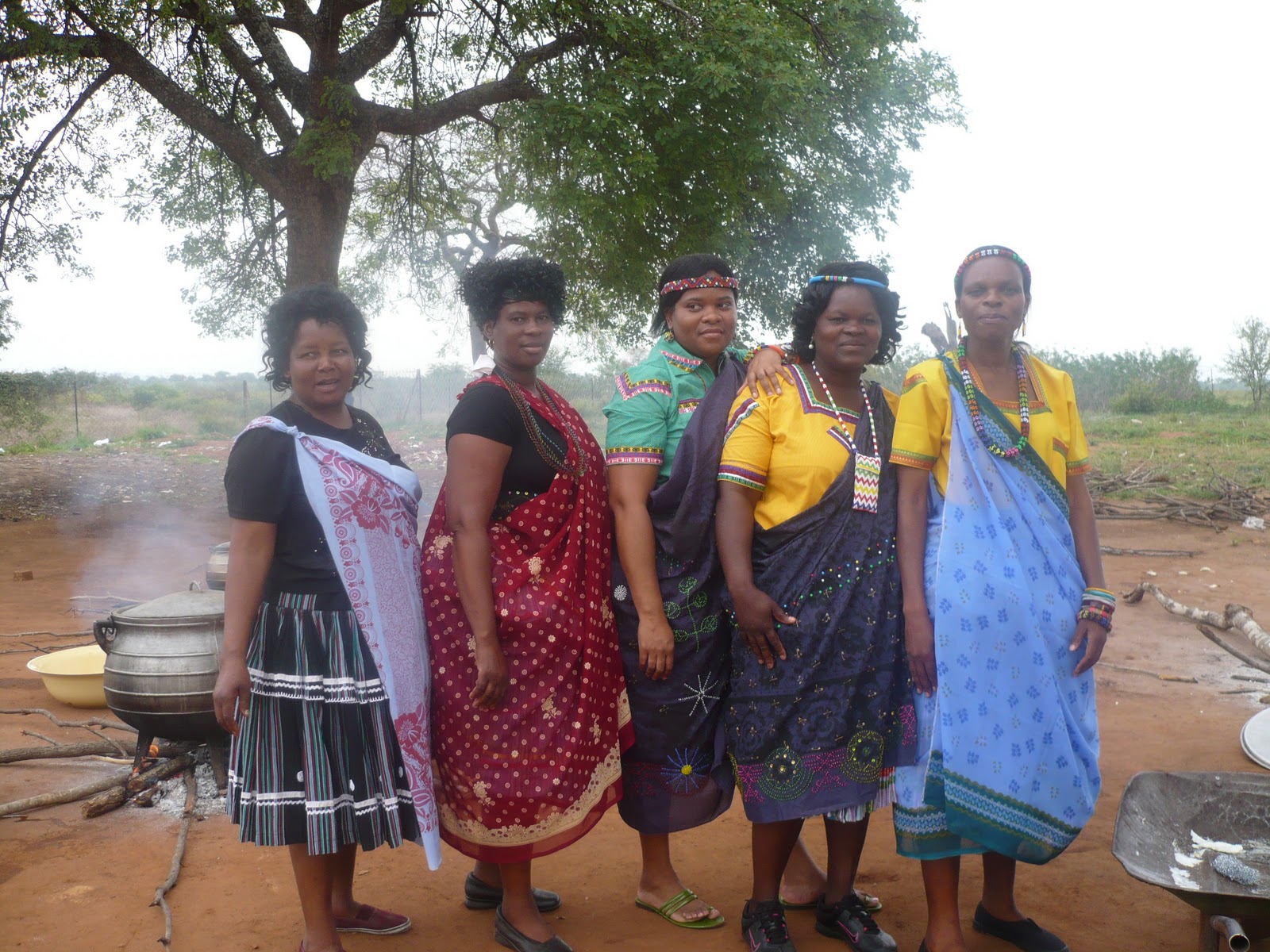
                I was glad to recover and get back to work.  This week has been a really good week at both of the schools.  I am continuing with the journals with grades 6 & 7, and the students seem to be opening up and writing longer answers, which I was thrilled to see.  Also, my grade 7 students are improving their scores on their vocabulary quizzes – this week 5 of the students received perfect scores, and a bunch of the students scored either a 90% or 80%.  I was really glad to see this!  Studying really pays off!  I worked with the Grade 2 teacher at one of my schools, having her students practice writing letters/numbers outside in the dirt.  The students loved it!  In addition, on Friday one of the schools had the Grade R Graduation Ceremony.  In order to celebrate properly, all of the teachers and all of the students came to school dressed in their traditional Xitsonga clothing.  When I arrived to school, in my ever-so exciting plain dress and cardigan, hands flew!  Within minutes I became the first ever Tsonga Barbie, and was dressed head to toe in Tsonga clothing.  It was awesome!  Throughout the day we all danced Xibelani (the traditional Tsonga dance), had guest speakers to motivate the students and congratulate them on all of their hard work, presented the graduates with certificates of achievement, and ate lots of delicious food (and of course, drank cold drink!)  The Grade R students even had their own graduation caps and robes – ADORABLE!!

                Next week I am going to work with Grades 6 & 7 on teaching them about HIV/AIDS, in order to participate in another PCV’s project: Peace Corps South Africa World AIDS Day Art Exchange.  I went to the local clinic to see if one of the nurses/doctors would be able to come speak to the students (since I’m really no expert).  In case this does not come to fruition and no one shows up to speak, I am going to prepare a lesson to do with the students, discussing what they know, what they want to know, and then what they have learned from the lesson (KWL).  After the lesson (which will be one day), I will have the students create art centering on the 2011 World AIDS Day theme, “It takes a village to fight HIV!” or “Swi teka tiko ku hlasela HIV!”  I’m hopeful that someone from the clinic can come, because guest speakers are always fun for students, and he/she will know much more than I do on the topic.  Also, he/she will be able to communicate the information in both English and in the students’ home language.  After the students give me their art work, I will exchange the art with another PCV and submit a few pieces to the Peace Corps Office.

                I’m really looking forward to the 21st of the month, because I will be meeting with both of my principals to discuss my first few months at site.  I’ll give my feedback, and they will also give me feedback on how I have been doing.  During this meeting, we will discuss my observations, ideas I have for both of the schools, projects they would like me to work on next year, etc.  One of the biggest things I want to do is to start holding monthly teachers’ workshops.  I think this would be a great way to share ideas and different teaching practices with the teachers.  I'd also like to do the "Peace Corps World Map Project" at the schools.

                The next month/2 months are really busy!!  For Thanksgiving, I will be traveling to Vhembe to celebrate Thanksgiving with some other PCV’s.  Thanksgiving is my favorite holiday, so I know I’ll be missing home (especially the Gobble Wobble with the family, Pammycake’s pineapple stuffing, and Mrs. Meister’s famous pies).  It will be really nice to celebrate with the other PCV’s since there is no Thanksgiving here.  Straight after Thanksgiving I’ll be heading back to Makapanstad (where we did our training) for my first host brother’s wedding.  I haven’t been to a wedding since training, so I’m wicked excited.  Weddings here are so exciting.  Literally anyone and everyone comes.  From the 5th-15th of December, our entire group (SA24) meets for training.  Aside from the fact that I’ll get to see everyone I haven’t seen since swearing in, I’m also looking forward to this because we get to bring a counterpart with us.  I am bringing my host mom, because she is involved in the Drop-In Centre for the OVC (Orphans and Vulnerable Children).  This will be beneficial since there will be trainings on Life skills, HIV/AIDS and proposals/grant writing for funding.  I’ll be at site again from the 15th-23rd, and then I’ll head out for my Christmas holiday for hiking and general merriment. 

If I don’t get the chance to blog again until after the holidays, Happy Holidays everyone!!
Miss and love you all!

Salang Gabotse!
Meg J